
AI agents have become one of the loudest technology trends of 2026, with vendors promising software that can research, plan, communicate, operate business tools, and complete entire workflows with minimal human involvement. Unlike ordinary chatbots, agents are designed not only to generate responses but also to take actions toward a goal. For businesses, the challenge is determining which of these capabilities are reliable enough for production and which still work better in carefully controlled demonstrations than in everyday operations.
What an AI agent actually is vs. a chatbot
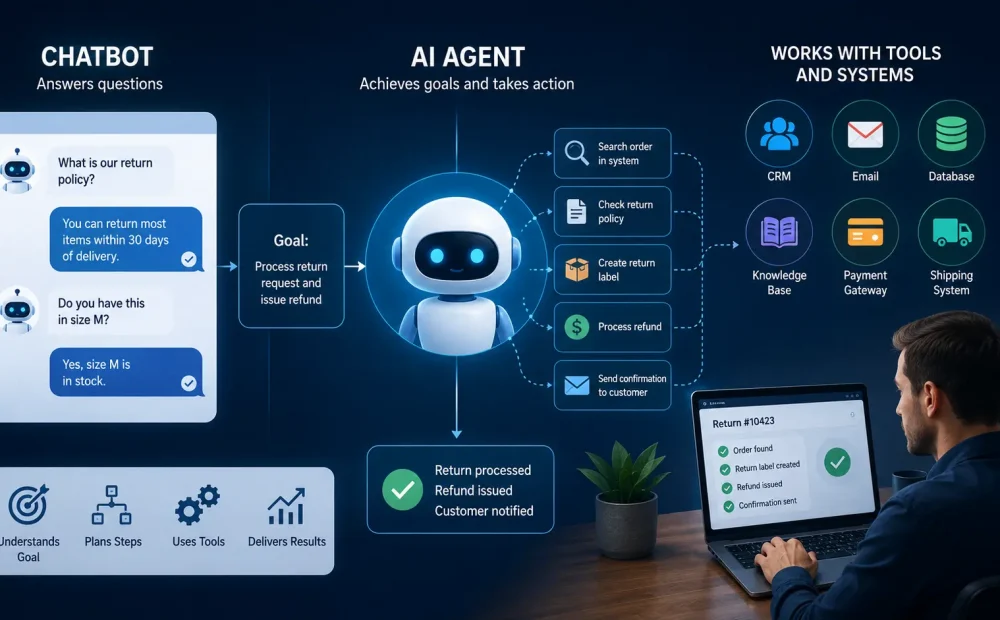
An AI agent is a system that can pursue a goal through multiple steps, use external tools, observe the results of its actions, and decide what to do next, while a conventional chatbot primarily responds to individual user inputs.
A standard chatbot follows a relatively simple interaction pattern: the user sends a message, the model generates a response, and the conversation continues. Modern chatbots may have access to files, search tools, or business data, but the interaction is still usually centered on answering a person’s immediate request.
An agent introduces another layer of orchestration. Instead of receiving detailed instructions for every action, it can be given a broader objective and determine which intermediate steps are necessary. It might search a database, retrieve information from a CRM, analyze several documents, call an API, create a draft, check the result, and then continue based on what it discovers.
This does not mean that an agent “thinks” or operates like a human employee. Under the hood, it remains a software system combining AI models with instructions, tools, permissions, memory or stored context, and rules governing what actions it can perform.
The most important distinction is therefore autonomy within defined boundaries. A chatbot primarily communicates. An agent can potentially communicate and act.
What AI agents can genuinely do right now
Today’s most useful AI agents handle bounded, tool-based workflows in which goals, available actions, data sources, and escalation rules can be clearly defined.
The strongest applications tend to involve digital processes where an agent can work through existing software and where its output can be checked before consequential actions are finalized.
- Research and information synthesis. Agents can search approved sources, collect relevant information, compare findings, summarize documents, and prepare structured research for human review.
- Customer support assistance. They can classify requests, retrieve account or product information, draft responses, suggest troubleshooting steps, and route unusual cases to human specialists.
- Internal workflow automation. Agents can move information between business systems, update records, generate routine documents, organize incoming requests, and trigger predefined processes.
- Software development tasks. Coding agents can inspect repositories, propose or make code changes, run tests, investigate errors, update documentation, and assist developers with repetitive engineering work.
- Monitoring and operational tasks. Agents can periodically check defined data sources or systems, identify changes, prepare reports, and escalate situations that match predetermined conditions.
These capabilities become significantly more valuable when an agent is connected to reliable tools and high-quality organizational data. A language model alone may be able to suggest what should happen; an agent connected to business systems can potentially carry out parts of that process.
The most successful implementations usually do not attempt to reproduce an entire employee’s job. Instead, they automate specific sequences of work with clear inputs, outputs, permissions, and checkpoints.
Where real capability ends and hype begins
The gap between a convincing agent demonstration and a reliable production system appears when the software encounters ambiguity, unexpected conditions, incomplete information, or consequences that cannot easily be reversed.
A demonstration can be optimized around a predictable scenario. The agent receives clean data, the required integrations work correctly, and the task resembles examples the system handles well. Real businesses are considerably messier.
Customers provide incomplete information. Internal databases contain outdated records. APIs fail. Documents contradict one another. Permissions change. A seemingly simple request may involve an exception that was never included in the original workflow.
Agents can also make incorrect assumptions while producing outputs that appear confident and coherent. Giving such a system access to tools creates an important distinction between a wrong answer and a wrong action. An inaccurate paragraph can be corrected; an incorrect database update, customer message, purchase, or configuration change may have operational consequences.
Claims about fully autonomous “digital employees” should therefore be evaluated carefully. Agents can already complete impressive sequences of work, but reliability generally decreases as tasks become longer, less structured, and more dependent on judgment.
The relevant business question is not whether an agent can complete a workflow once. It is whether it can complete the workflow reliably across hundreds or thousands of real cases, recognize situations outside its competence, and escalate appropriately when something goes wrong.
How to tell a working use case from a marketing demo
A production-ready agent should be evaluated by repeatable performance under realistic conditions rather than by how impressive a single successful demonstration looks.
Businesses can apply four basic tests:
- Define a measurable task. Replace broad goals such as “automate customer service” with specific outcomes such as categorizing support tickets, retrieving relevant account information, drafting responses, or resolving a clearly defined category of requests.
- Test realistic edge cases. Include incomplete requests, conflicting information, unavailable tools, unusual inputs, permission problems, and situations where the correct action is to stop and ask for human assistance.
- Measure end-to-end performance. Track accuracy, completion rates, human correction rates, processing time, cost, escalation frequency, and the consequences of failures rather than relying only on model benchmarks.
- Run the system repeatedly. A useful agent must perform consistently across a representative volume of real tasks. One successful workflow proves possibility; repeated successful execution provides evidence of operational value.
Businesses should also examine what happens behind the interface. Some products marketed as autonomous agents rely heavily on predefined workflows, templates, human intervention, or conventional automation.
That is not necessarily a weakness. A hybrid system combining deterministic software with AI may be considerably safer and more useful than an agent given broad freedom to decide everything itself. What matters is whether the architecture reliably solves the business problem.
Common limitations and risks of deploying agents
Giving AI the ability to take actions creates risks that go beyond the familiar problem of inaccurate model responses.
Reliability remains a fundamental limitation. Agents may misunderstand instructions, select an inappropriate tool, retrieve irrelevant information, repeat actions, or construct an incorrect plan. Errors can also accumulate across multi-step tasks: a small mistake early in a workflow may influence every subsequent decision.
Security becomes especially important when agents have access to email, databases, internal documents, code repositories, payment systems, or administrative tools. Organizations need strict controls over what each agent can read and what actions it can perform.
External content creates additional risks. An agent that reads websites, emails, documents, or other untrusted material may encounter malicious instructions designed to influence its behavior. Systems therefore need defenses against prompt injection and related attempts to manipulate tool-using AI.
Data governance is another consideration. Companies must understand which information is sent to models, where it is processed, how long it is retained, and whether access complies with internal policies and applicable legal or regulatory requirements.
Cost can also become unpredictable. Complex agent workflows may involve numerous model calls, searches, tool executions, retries, and validation steps. A task that appears inexpensive in a small pilot can become materially more costly at production scale.
Finally, accountability must remain clear. If an agent makes an incorrect decision, the organization still needs to know who owns the workflow, who investigates failures, and who has authority to change or disable the system.
How businesses can assess readiness to adopt AI agents
A company is ready for AI agents when it has sufficiently structured processes, accessible data, reliable integrations, clear ownership, and the ability to monitor automated actions.
The best starting point is usually an existing workflow rather than an abstract desire to “implement agents.” Teams should identify repetitive digital work that consumes meaningful employee time and can be described as a sequence of understandable decisions and actions.
Process maturity matters. If employees cannot agree on how a task should normally be performed, automating it with an agent may simply automate organizational confusion. Standard operating procedures, clear exceptions, and defined escalation paths make agent deployment much easier.
Technical readiness matters as well. Agents become more useful when business systems provide stable APIs, structured permissions, reliable identity management, and accurate data. Companies should be able to restrict access according to the principle of least privilege rather than giving an agent broad credentials simply because integration is easier.
The next question is reversibility. Early deployments are safer when actions can be reviewed, corrected, or undone. An agent that drafts an email for approval presents much less risk than one that independently sends thousands of messages. Similar logic applies to financial transactions, production infrastructure, customer records, and other sensitive operations.
Human oversight should therefore be designed according to consequence. Low-risk actions may eventually run automatically after sufficient validation, while high-impact decisions may always require approval.
Businesses should also establish monitoring before scaling. Logs should make it possible to determine what the agent attempted, which tools it used, what information influenced its actions, whether the workflow succeeded, and when human intervention was required.
AI agents in 2026 are neither merely chatbots with a new label nor universally capable autonomous workers. Their practical value lies between those extremes. They are increasingly effective at carrying out bounded digital workflows, particularly when businesses combine capable models with reliable tools, carefully limited permissions, measurable evaluation, and human oversight. Companies that start with specific operational problems rather than promises of unlimited autonomy are more likely to find where agents can create genuine value.