

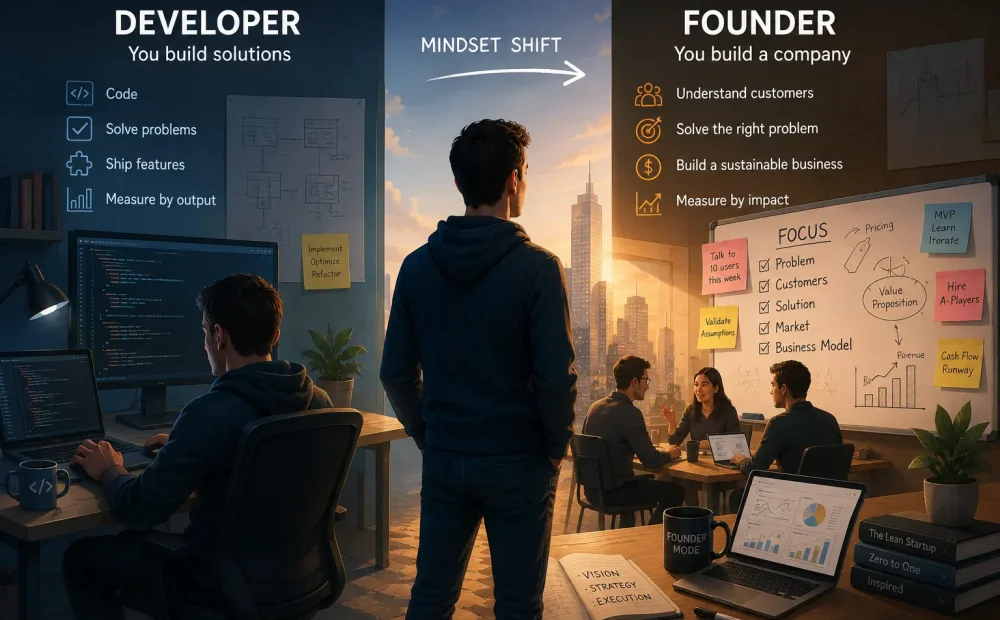
Many developers eventually consider becoming founders because building a startup initially feels like an extension of what they already do: identify a problem, design a solution, and build it. The transition can therefore look deceptively familiar from the outside. But the skills that make someone an excellent engineer—technical depth, precision, and the ability to create reliable systems—do not automatically provide the sales, prioritization, leadership, and market judgment required to build a successful company.
Why writing code and building a product are not the same skill
Engineering is primarily about creating solutions, while building a product requires proving that a sufficiently important problem exists and that people are willing to adopt or pay for the solution.
Developers are trained to think in terms of implementation. Given a reasonably clear problem, they evaluate architecture, technologies, performance, reliability, maintainability, and technical trade-offs. Progress can often be measured through working functionality.
Founders operate with a different kind of uncertainty. The biggest unknown may not be how to build something but whether it should be built at all.
A technically impressive product can fail because customers do not consider the problem important enough, existing alternatives are already sufficient, the target market is too small, distribution is too expensive, or users simply do not understand why they should change their current behavior.
This creates an uncomfortable shift for technically minded founders. Writing another feature feels productive because the output is visible. Interviewing prospective customers, testing positioning, changing pricing, or abandoning an assumption can feel less concrete, even when those activities are more important to the company’s survival.
The founder’s objective is therefore not to maximize the amount of software produced. It is to discover a repeatable way of creating and capturing value.
What actually changes in your day-to-day priorities
Becoming a founder means moving from responsibility for a technical system to responsibility for the entire system that turns a problem into a sustainable business.
The change becomes particularly visible in how time is allocated:
- From implementation to prioritization. Instead of asking how to build every requested feature, you increasingly decide which problems deserve engineering time and which should be ignored.
- From code to customers. Conversations with users, prospects, partners, and lost deals become a major source of information about what the company should build next.
- From technical quality to business outcomes. Elegant architecture matters, but activation, retention, revenue, conversion, acquisition cost, and customer satisfaction increasingly determine whether the product is succeeding.
- From individual output to team leverage. As the company grows, your impact depends less on how much code you personally write and more on whether other people can make good decisions and execute effectively.
- From solving defined problems to managing uncertainty. Founders routinely make decisions with incomplete data about markets, hiring, pricing, positioning, fundraising, and product direction.
For many developer-founders, this shift can initially feel like becoming less productive. A day spent coding produces visible commits. A day spent interviewing candidates, talking to customers, reviewing financial assumptions, and negotiating a partnership may produce nothing tangible.
Yet those activities can have substantially greater impact on the company.
New skills founders need that engineering school never taught
The hardest part of becoming a founder is often learning the commercial and interpersonal skills that technical work allowed you to avoid.
Sales is one of the most important examples. Early-stage founders need to persuade customers to try a product that may still be incomplete, convince talented people to join a risky company, negotiate with suppliers and partners, and sometimes persuade investors that the opportunity is worth financing.
Customer discovery is another distinct skill. Asking users what features they want is relatively easy but frequently misleading. Founders need to understand existing behavior, identify costly or frustrating problems, determine how customers currently solve them, and distinguish genuine purchasing intent from polite enthusiasm.
Positioning and communication matter as well. A technically sophisticated product has limited value if prospective customers cannot quickly understand what it does, who it is for, and why it is better than their current alternative.
Financial literacy becomes increasingly important as the company grows. Founders need to understand revenue, margins, cash flow, runway, hiring costs, pricing economics, and how different growth scenarios affect the survival of the business.
Leadership may be the largest transition of all. Engineering problems generally respond to logic and experimentation. People bring motivations, disagreements, emotions, incentives, communication styles, and personal ambitions. Managing those dynamics requires a different toolkit.
None of these skills require abandoning an engineering mindset. They require expanding it into areas where inputs are less structured and outcomes are harder to predict.
How to make the transition without losing your technical edge
The goal is not to stop being technical but to use technical expertise as an advantage while gradually transferring your time toward the company’s highest-leverage problems.
A practical transition can follow four steps:
- Stay close to the product, but stop measuring yourself by code output. Continue understanding architecture and major technical decisions while evaluating your contribution according to company outcomes rather than commits.
- Put customer conversations on the calendar. Treat customer discovery and sales with the same discipline you once applied to development. Regular exposure to real users prevents product decisions from being driven entirely by internal assumptions.
- Delegate implementation before technical judgment. As the team grows, let other engineers own increasing amounts of code while remaining capable of evaluating technical trade-offs, asking good questions, and identifying unnecessary complexity.
- Build competence outside engineering deliberately. Learn sales, finance, hiring, negotiation, marketing, and management through actual practice instead of waiting until each becomes an emergency.
Maintaining technical literacy can remain a significant founder advantage. It allows you to understand development constraints, evaluate technical hires, communicate effectively with engineers, and recognize when something genuinely requires months of work versus when complexity is being overstated.
The danger is not remaining technical. The danger is continuing to behave like the company’s senior individual contributor when the business needs a founder.
Common mistakes developers make when they become founders
Developer-founders often struggle not because they lack technical ability, but because they keep applying engineering instincts to problems that require market validation, communication, or organizational judgment.
One common mistake is building too much before talking to customers. Months can disappear into architecture, infrastructure, dashboards, settings, integrations, and edge cases before anyone has demonstrated meaningful demand for the core product.
Overengineering is closely related. Engineers naturally want systems that are scalable, maintainable, and technically clean. Early-stage companies, however, often need to discover whether the product deserves to scale before investing heavily in infrastructure designed for hypothetical future demand.
Another mistake is avoiding sales. Some technical founders assume that a sufficiently good product will spread naturally. Occasionally it does, but most products need distribution. Someone must identify potential customers, explain the value proposition, overcome objections, and ask for the sale.
Hiring can create another trap. Developers may evaluate technical candidates primarily through technical competence while underestimating communication, ownership, adaptability, and the ability to operate under uncertainty. Early employees influence the company far beyond their immediate output.
Founder-developers may also remain the bottleneck for too long. If every technical decision, pull request, deployment, customer issue, and product choice requires the founder’s approval, the company cannot scale beyond that person’s attention.
Perhaps the deepest mistake is treating uncertainty as a reason to keep building. In engineering, additional work often brings a system closer to completion. In startups, additional development does not necessarily bring the company closer to product-market fit.
Sometimes the correct next action is another commit. Sometimes it is a conversation with ten customers.
Signs you’re actually thinking like a founder now
You begin thinking like a founder when your default question changes from “What should I build?” to “What is the most important constraint preventing this company from succeeding?”
Sometimes that constraint is technical. The product may be unreliable, slow, insecure, or missing a capability customers genuinely require. In that case, writing code may be exactly where the founder should spend time.
But the constraint may also be distribution. Or positioning. Or onboarding. Or pricing. Or hiring. Or retention. Or cash.
Founder thinking means being willing to work on whichever problem has the greatest impact, even when it falls outside your strongest skill set.
You also become more comfortable shipping imperfect solutions when the purpose is to learn. Instead of optimizing every component before release, you distinguish between decisions that are expensive to reverse and those that can be corrected after receiving real-world feedback.
Metrics begin to replace intuition in appropriate areas. You pay attention not only to whether users say they like the product but whether they activate, return, pay, expand usage, and recommend it.
Your relationship with technical work changes as well. You can still care deeply about engineering quality without treating technical elegance as the company’s ultimate objective. You become comfortable accepting reasonable technical debt when speed matters and equally comfortable slowing development when reliability or security genuinely requires it.
Most importantly, you stop defining your contribution by the tasks you personally complete. A developer creates leverage through software. A founder creates leverage through software, people, capital, distribution, processes, and decisions.
The transition from developer to founder is therefore less about leaving engineering behind than expanding the scope of the system you are responsible for. Code remains one of your tools, and technical expertise can remain a powerful competitive advantage. But once you become a founder, the company itself becomes the system you are building.