

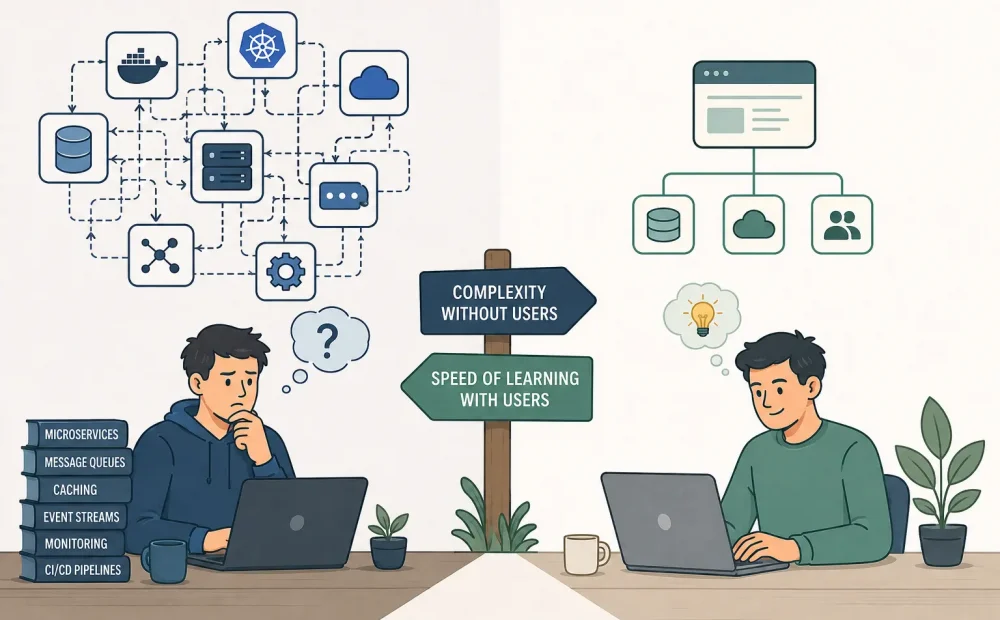
Early-stage founders often choose technology as if they were already preparing for millions of users: microservices, distributed infrastructure, multiple databases, elaborate deployment pipelines, and layers of abstraction appear before the product has meaningful traffic. The problem is not that these technologies are bad, but that every additional component consumes time and attention that could be spent learning what customers actually need. At the idea stage, the best stack is usually the one that helps a team test assumptions and ship changes quickly, not the one that looks most impressive on an architecture diagram.
Why founders overengineer their stack before they need to
Founders overengineer because technical problems feel predictable and controllable, while the real uncertainties of an early startup—demand, positioning, pricing, and customer behavior—are much harder to solve.
For technical founders in particular, architecture is familiar territory. Choosing databases, designing services, configuring infrastructure, and improving performance provide concrete problems with measurable solutions. Customer discovery is much less comfortable: people contradict each other, assumptions fail, and there may be no obvious correct answer.
Building for hypothetical scale can therefore become a form of premature optimization. A team expects the product to grow rapidly, so it designs infrastructure for traffic that does not exist yet. It introduces microservices because large technology companies use them, Kubernetes because deployment may eventually become complicated, or multiple specialized databases because different workloads might appear in the future.
The reasoning often sounds responsible. Founders want to avoid rebuilding the product later.
But early-stage startups are far more likely to change their product than to immediately outgrow a sensible conventional architecture. The customer segment may change. The core workflow may be redesigned. Features may disappear. The business model may evolve completely.
Optimizing architecture for an uncertain future can therefore mean investing heavily in assumptions that will never become true.
Technical ambition is valuable, but at the idea stage it needs to serve learning. The architecture should make experimentation easier rather than protect the company from scale it has not yet earned.
Signs your tech stack is more complex than your stage requires
A stack is probably overengineered when maintaining the infrastructure consistently takes more effort than validating and improving the product itself.
Several warning signs are especially common:
- You have more services than meaningful product domains. If a tiny team operates numerous independently deployed services for a relatively simple product, service boundaries may be creating more coordination than flexibility.
- Infrastructure work regularly delays customer-facing changes. Engineers spend days maintaining pipelines, networking, clusters, observability, or internal tooling while basic product experiments wait.
- You are solving hypothetical scaling problems. The team discusses sharding, multi-region deployments, complex caching strategies, or enormous concurrency requirements without measurements showing that current infrastructure is approaching its limits.
- Only one person understands important parts of the stack. Specialized infrastructure can create knowledge bottlenecks, particularly in small teams where every engineer needs to work across multiple areas.
- Changing a basic feature requires touching many systems. If a simple product experiment demands updates across several services, queues, schemas, deployment configurations, and APIs, architectural complexity may be slowing the learning cycle.
None of these technologies are inherently inappropriate. A queue, container orchestrator, separate service, or specialized database can solve a genuine problem.
The question is whether that problem exists today.
Complexity should usually be introduced in response to a demonstrated constraint. When infrastructure is added because it might become useful eventually, the startup begins paying its cost immediately while receiving only hypothetical benefits.
What actually matters when choosing a stack at the idea stage
At the idea stage, a technology stack should optimize primarily for development speed, team familiarity, easy iteration, reasonable reliability, and access to existing tools and services.
The first consideration should be what the team already knows well.
A familiar framework that allows developers to build a working product this week is often more valuable than a theoretically superior technology that requires weeks of learning. Early startups gain an advantage from short feedback loops, and familiarity reduces the distance between an idea and something customers can actually use.
The ecosystem matters too. Mature frameworks often provide libraries, authentication solutions, database integrations, documentation, testing tools, deployment options, and answers to common problems. These existing resources can eliminate large amounts of unnecessary custom engineering.
Operational simplicity is another major factor. A stack that can be deployed through a straightforward managed service allows a small team to spend less time maintaining infrastructure. Managed databases, object storage, authentication, monitoring, email delivery, and similar services can be particularly valuable when those capabilities are not part of the startup’s differentiation.
Hiring should be considered, but not overestimated. Using an extremely obscure technology can make future recruitment difficult. At the same time, choosing an entire architecture based on what a hypothetical team of 200 engineers might need is premature.
Finally, consider reversibility. Some technology choices are easier to change than others. A UI library can often be replaced incrementally. Moving away from a deeply integrated database architecture or cloud-specific infrastructure may be substantially harder.
Spend more time evaluating decisions that are expensive to reverse and less time optimizing choices that can be changed relatively easily.
A simple framework for picking your stack without overthinking it
A good early-stage stack can be selected by starting with product requirements, preferring familiar mainstream technology, minimizing infrastructure, and documenting the few assumptions that might force a future change.
A simple four-step process is usually enough:
- Write down what the product actually needs now. Identify concrete requirements such as authentication, payments, file storage, search, real-time updates, background processing, integrations, or specific performance constraints. Avoid requirements based entirely on imagined future scale.
- Choose technologies the team can ship with quickly. Prefer tools with which the founders already have production experience or can become productive rapidly. Established frameworks and databases are often strong defaults because their limitations are well understood.
- Buy or use managed services for non-differentiating infrastructure. If authentication, email, monitoring, storage, deployment, or another capability does not create unique customer value, evaluate whether an existing service can handle it more efficiently than custom code.
- Define the conditions that would justify changing the architecture. Instead of building for every possible future scenario, decide what evidence would trigger investment: sustained database pressure, unacceptable latency, reliability requirements, team coordination problems, regulatory constraints, or rapidly increasing infrastructure costs.
This framework turns architecture from speculation into a series of evidence-based decisions.
It also makes technical debt more deliberate. A startup can consciously accept a simple implementation today if the team understands its limitations and knows approximately what signals would indicate that it needs to change.
The goal is not to avoid technical debt completely. Some technical debt is the price of learning quickly. The important distinction is between debt that accelerates validation and careless decisions that create unnecessary risk.
The real cost of overengineering too early
The biggest cost of premature technical complexity is not the cloud bill—it is the slower rate at which a startup can learn from customers and change direction.
Every additional infrastructure component has a lifecycle.
It needs to be configured, secured, monitored, upgraded, documented, debugged, backed up, and understood by the team. Dependencies interact. Version compatibility becomes relevant. Local development gets harder. Production incidents have more possible causes.
For a large organization, these costs may be justified by scale or organizational requirements. For a three-person startup, they can consume a significant percentage of total engineering capacity.
Complexity also slows product changes. In a simple architecture, an engineer may be able to change a data model, update application logic, deploy it, and collect feedback within hours. In a distributed architecture, the same experiment might require API changes, coordination between services, schema migrations, event compatibility, and several deployments.
That difference matters because early startups operate through repeated learning cycles:
build, release, observe, learn, adjust.
The faster those cycles run, the more assumptions the company can test before its money and time run out.
Overengineering can also make pivots psychologically harder. After months of investment in sophisticated infrastructure, teams become reluctant to abandon the product assumptions around which that infrastructure was designed. Technical sunk costs begin influencing product decisions.
There is also an opportunity cost. Every week spent solving infrastructure problems is a week not spent improving onboarding, talking to customers, fixing retention, testing pricing, or building the feature that might actually create demand.
A technically elegant system cannot compensate for a product nobody needs.
When it’s actually time to invest in a more robust stack
A startup should increase architectural sophistication when real usage, reliability requirements, security constraints, team growth, or measurable performance problems make the existing approach a genuine business limitation.
Traffic is one obvious trigger, but it should be measured rather than anticipated. If the database consistently approaches capacity, requests regularly exceed acceptable latency, background jobs cannot keep up, or application servers remain heavily utilized despite straightforward optimization, additional infrastructure may be justified.
Reliability can create an earlier trigger. A product handling critical customer workflows may need redundancy, stronger backup processes, failover, improved monitoring, or better isolation even with relatively modest traffic. The business impact of failure matters more than raw request volume.
Security and compliance can also change the equation. Enterprise customers or regulated industries may require stricter access controls, auditability, data isolation, specific hosting arrangements, or more sophisticated secrets and identity management.
Team growth is another legitimate reason to evolve architecture. A monolith may scale technically while becoming difficult for multiple engineering teams to modify independently. Separating parts of the system can then solve an organizational bottleneck rather than a performance problem.
Cost can become a trigger as well. Managed services that are ideal at low volume may become disproportionately expensive at scale. Bringing selected infrastructure in-house or replacing a convenient abstraction may eventually produce meaningful savings.
The important pattern is that each of these changes responds to evidence.
Start with the simplest stack that can deliver the product reliably. Measure its behavior. Understand where its limits are. Keep boundaries clean enough that important components can evolve later, but do not implement every possible future architecture in advance.
When a constraint becomes real, solve that constraint.
For an early-stage startup, technical excellence is not measured by how closely its infrastructure resembles that of a mature technology company. It is measured by whether the technology helps the company learn quickly, serve its current users reliably, and preserve enough flexibility to respond when reality turns out differently from the original plan.